
This analysis, originally written in 2023, was the winner of the Foreign Policy Association of Central Pennsylvania’s Student Scribe Scholarship essay contest.
One of the most significant and challenging foreign policy issues facing the United States of America in the next decade is expanding and ensuring close ties with the Republic of India. As of 2023, India stands as the world’s most populous country and the world’s largest democracy. India also boasts a rapidly growing economy projected to become one of the world’s most powerful. Establishing a robust and cooperative relationship between the United States and India is vital in countering China’s influence, particularly as the United States continues to shift its strategic focus towards the Indo-Pacific.
However, India’s geopolitical position is complex and defies easy categorization within the Eastern or Western geopolitical spheres. This enigma challenges the United States’ conventional approach to international relations. Factors such as India’s close relations with Russia and its aspirations to become a great power pose significant obstacles for US leaders in their pursuit of fostering closer bilateral relations within the next decade.
The difficulties in the United States-India relationship can be traced back to India’s independence from the United Kingdom in 1947. At that time, India sought to chart its own course in international affairs after a century of British rule.[1] With tensions escalating between the West and the Soviet Union, India aimed to remain neutral, which caused consternation among key US foreign policy officials who believed there could be no neutrality in the fight against Communism.[2]
The international relationship between India and the United States became even more intricate in the following decades. While the United States publicly supported India during the 1962 Sino-Indian War, it also provided substantial economic, political, and aid-related support to India’s primary rival, the Islamic Republic of Pakistan. In contrast, the Soviet Union offered significant military and economic assistance to India.[3] These dynamics, combined with improving ties between the United States and the People’s Republic of China following the Sino-Soviet split, contributed to the creation of an amicable and cooperative relationship between the USSR and India.
After the collapse of the Soviet Union, this warm relationship continued between the Russian Federation and India, which contributed to relative indifference in Washington towards establishing more productive relations with New Delhi.[4] Indian leaders have also aimed to rapidly develop not only the country’s economy but also its geopolitical influence. Since the 1990s, India has experienced record GDP growth, leading to international recognition that India will likely become a world power or even a superpower in the coming decades.
This growth will bring about a changing attitude regarding how India interacts with the rest of the world in its international relations. Indian leaders will increasingly pursue policies that align with and facilitate India’s global ambitions. These leaders will likely push for more equitable bilateral relations that better serve India’s interests.[5] These factors could pose challenges to traditional US hegemonic foreign policy India is likely to resist pressure from the United States when policy concerns not shared by the two countries. For example, Indian leaders have disregarded US calls for economic sanctions against the Russian Federation following the Russian invasion of Ukraine.[6] Instead, India has increased its imports of Russian oil and displayed ambivalence towards Western policies against Russia.
Nevertheless, India and the US continue to cooperate on key issues, especially those related to the balance of power in the Indo-Pacific. India is a member of the Quadrilateral Security Dialogue, known as the Quad, alongside the United States, Japan, and Australia. This group aims to cooperate and formulate policies for a free and open Pacific through dialogue summits.
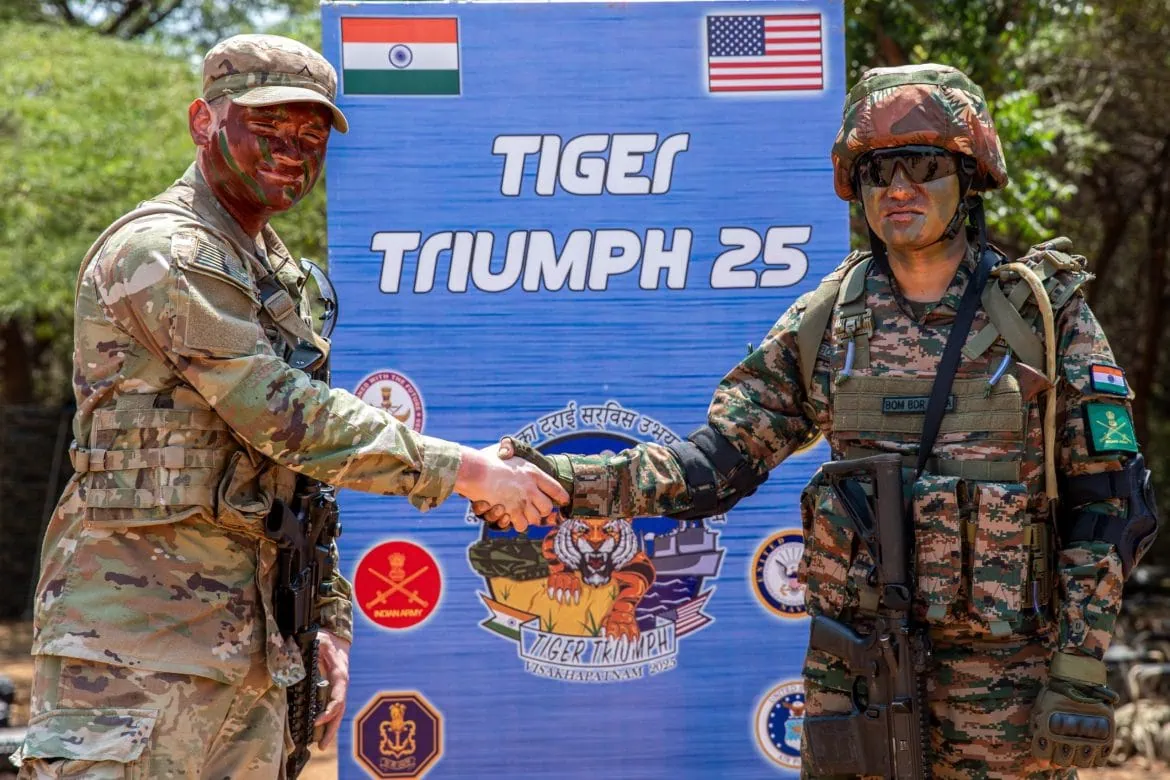
For the United States, cooperation with India in security and defense presents a substantial opportunity to strengthen relations and foster a truly mutual partnership in these and other areas. By pursuing these diplomatic channels, the United States can demonstrate that India’s security is a legitimate and vital concern for Washington, rather than a transient strategic interest.
Furthermore, increasing cooperation with India within its security and defense sectors aligns with multiple long-term strategic goals of the United States. These goals include constraining the global power and influence of Russia, particularly in military terms, and supporting and cooperating with a capable counterbalance to Chinese power in Asia and the Pacific.
India has deeply cooperated with the Russian military over the past decades and has heavily integrated Russian military hardware into its armed forces, with an estimated 85% of Indian military platforms originating from Russia in 2020.[7] However, Russia’s dominance over Indian arms imports has decreased due to Russian military setbacks in Ukraine and international sanctions.[8]
The United States has a clear opportunity to pursue greater cooperation with India through defense industries. This would not only fulfill India’s critical need for arms imports but would also foster goodwill, akin to the Soviets in the second half of the 20th century. The United States also has the ability to facilitate greater industrial and defense cooperation between India and the United States, promoting long-term collaboration that reduces Russia’s role in India and extends cooperation beyond a focus on just countering China.
Washington has taken steps within the past years and decades to foster this closer relationship. In 2016 the United States Congress designated India as a “Major Defense Partner” and since 2008 India has procured nearly $20 Billion in military equipment from the United States.[9] In 2023, both nations took “consequential” steps in their bilateral relations with India and the United States agreeing to drop WTO trade disputes between each nation and landmark agreement for the US-based General Electric to co-produce jet-engines for an Indian domestic fighter-jet program.[10] Both of these actions are major steps to creating a more cohesive and cooperative ties between Washington and New Delhi.
Nonetheless, current US approaches and foreign policy demands present their own challenges. Pakistan remains a Major Non-NATO Ally of the United States and is a key recipient of US military aid. This relationship creates substantial unease in India.[11] In the current state of relations among the three nations, the United States must either reevaluate its relationship with Pakistan, an ally with whom it has increasingly disagreed with or find a way to foster diplomacy and understanding between India and Pakistan, which will perhaps pose a greater challenge.
If leaders of the United States seek the benefits that Indian partnership in the Indo-Pacific provides, they must fully establish a cooperative and mutually beneficial relationship. To achieve this, the United States must transform its traditional methods of diplomacy from one which often appear heavy-handed and one-sided. Establishing a diplomatic relationship that recognizes India as a full-fledged partner that will grow significantly in power within the next decades, instead of just a means to an end, will be essential. This transformation will be challenging for the US foreign policy apparatus over the next decade, but the reward will be considerable.
[1] Sumit Ganguly and Manjeet S Pardesi, “Explaining Sixty Years of India’s Foreign Policy,” India Review 8 (2009): 4–19, https://doi.org/10.1080/14736480802665162.
[2] Alexey Davydov and A Kupriyanov, “US–Indian Relations: Formation of an Alliance or a Temporary Partnership?,” Herald of the Russian Academy of Sciences 92 (September 2022): S285–92, https://doi.org/10.1134/S1019331622100069.
[3] Lubna Sunawar and Tatiana Coutto, “U.S. Pakistan Relations during the Cold War,” The Journal of International Relations, Peace Studies, and Development 1, no. 1 (2015), https://scholarworks.arcadia.edu/cgi/viewcontent.cgi?article=1006&context=agsjournal.
[4] Rajan Menon and Eugene Rumer, “Russia and India: A New Chapter,” Carnegie Endowment for International Peace, September 20, 2022, https://carnegieendowment.org/2022/09/20/russia-and-india-new-chapter-pub-87958.
[5] Alyssa Ayres, “India Is Not a U.S. Ally—and Has Never Wanted to Be,” Time, June 21, 2023, https://time.com/6288459/india-ally-us-modi-biden-visit/.
[6] Josiah Johnson, “India Is Undermining US Aviation Sanctions on Russia,” AEI (American Enterprise Institute, April 3, 2023), https://www.aei.org/foreign-and-defense-policy/india-is-undermining-us-aviation-sanctions-on-russia/.
[7] Sameer Lalwani;Frank O’Donnell;Tyler Sagerstrom;Akriti Vasudeva, “The Influence of Arms: Explaining the Durability of India–Russia Alignment,” Air University (United States Air Force, January 15, 2021), https://www.airuniversity.af.edu/JIPA/Display/Article/2473328/the-influence-of-arms-explaining-the-durability-of-indiarussia-alignment/.
[8] Matthew Stein, “India Takes a Step Away from the Russian Defense Industry,” Journal of Indo-Pacific Affairs 6, no. 5 (2023): 138–45, https://original-ufdc.uflib.ufl.edu/AA00067831/00031.
[9] K. Alan Kronstadt, “India-U.S.: Major Arms Transfers and Military Exercises” (Washington, D.C.: Congressional Research Service, December 14, 2023), https://crsreports.congress.gov/product/pdf/IF/IF12438.
[10] Richard M. Rossow, “2023 Roundup: Small Steps and Big Shifts in U.S.-India Relations,” Center for Strategic and International Studies, January 2, 2024, https://www.csis.org/analysis/2023-roundup-small-steps-and-big-shifts-us-india-relations.
[11] Felix Chang, “India’s Neutrality and Strategic Relations with China, Russia, and the West – Foreign Policy Research Institute” (Foreign Policy Research Institute, April 25, 2022), https://www.fpri.org/article/2022/04/indian-foreign-policy-and-the-russian-ukrainian-war/.